Showing posts with label Entrepreneurship. Show all posts

Monday, 30 March 2015

4 Things You Need to Know about Change

1. There is no “new normal.” Things don’t stay the same long enough to normalize. And once you start thinkingthings are normal, you quit paying attention and get blindsided by the next change, big or small.
2. Singular solutions don’t exist. You can’t focus just on customer service and build a world-class company. Operations, finance, sales and marketing are just a few of the other truly critical areas that require ongoing attention.
3. Mastery of change requires both ability and speed. Given enough time, almost anybody can change. The key is to change faster than your competition or the demands of the marketplace.
4. Nobody will do it for you. There are no magic bullets. Sure, lots of people will help, advise, counsel and encourage. You might even hire a terrific coach or consultant to help you in needed areas. But ultimately you do the work.

Sunday, 22 March 2015

100 Leadership Quotes I’m Memorizing by End of 2015

100 leadership quotes to memorize
While some collect coins, spoons, stamps, I am an avid collector of quotes and books. Since I was 15, I have collected thousands of quotes. Two years ago, this avocation inspired me to create a quote book which I’m offering FREE to all my readers. As a student of leadership, I hope you will use these quotes as a resource for future blog posts, speeches, and books.
1. Leadership is lifting a person’s vision to higher sights, the raising of a person’s performance to a higher standard, the building of a personality beyond its normal limitations. — Peter. F Drucker
2. If your actions inspire others to dream more, learn more, do more and become more, you are a leader. — John Quincy Adams
3. Don’t tell people how to do things, tell them what do do and let them surprise you with their results. — George S. Patton
4. Leadership: The art of getting someone else to do something you want done because he wants to do it. — Dwight D. Eisenhower
5. Great leadership is about human experiences. It’s not a formula or a program. It is a human activity that comes from the heart and considers the hearts of others. It is an attitude, not a routine — Lance Secretan
6. Management is efficiency in climbing the ladder of success; leadership determines whether the ladder is leaning against the right wall. — Stephen R. Covey
7. Our chief want is someone who will inspire us to be what we know we could be. — Ralph Waldo Emerson
8. Leadership is a potent combination of strategy and character. But if you must be without one, be without the strategy. — Norman Schwarzkopf
9. If you want to build a ship, don’t drum up people to collect wood and don’t assign them tasks and work, but rather teach them to long for the endless immensity of the sea. — Antoine de Saint-Exupery
10. Treat a man as he is and he will remain as he is. Treat a man as he can and should be and he will become as he can and should be. — Johann Wolfgang von Goethe
11. A leader is one who knows the way, goes the way, and shows the way. — John C. Maxwell
12. A highly credible leader under-promises and over-delivers. — John C. Maxwell
13. Followers are the gem cutters of leadership coaxing out its full brilliance. — Ira Chaleff
14. A leader takes people where they want to go. A great leader takes people where they don’t necessarily want to go, but ought to be. — Rosalynn Carter
15. Only those who risk going too far can possibly find out how far one can go. — T.S. Eliot
16. The mediocre teacher tells. The good teacher explains. The superior teacher demonstrates. The great teacher inspires. — William Arthur Ward
17. Example is not the main thing in influencing others. It is the only thing. — Albert Schweitzer
18. In a battle between two ideas, the best one doesn’t necessarily win. No, the idea that wins is the one with the most fearless heretic behind it. — Seth Godin
19. Not all readers are leaders, but all leaders are readers. — Harry Truman
20. If you spend your life trying to be good at everything, you will never be great at anything. — Tom Rath
21. Great leaders are almost always great simplifiers, who can cut through argument, debate, and doubt to offer a solution everybody can understand. — Colin Powell
22. The first responsibility of a leader is to define reality; the last is to say thank you. In between, the leader is a servant. — Max De Pree
23. If I have seen farther than others, it is because I was standing on the shoulder of giants. — Isaac Newton
24. My own definition of leadership is this: the capacity and the will to rally men and women to a common purpose and the character which inspires confidence. — General Montgomery
25. The task of leadership is not to put greatness into people, but to elicit it, for the greatness is there already. — John Buchan
26. Personal leadership is the process of keeping your vision and values before you and aligning your life to be congruent with them. — Stephen Covey
27. A leader is a dealer in hope. — Napoleon Bonaparte
28. The ultimate measure of a man is not where he stands in moments of comfort, but where he stands at times of challenge and controversy. — Martin Luther King, Jr.
29. I start with the premise that the function of leadership is to produce more leaders, not more followers. — Ralph Nader
30. People buy into the leader before they buy into the vision. — John C. Maxwell
31. In matters of style, swim with the current; in matters of principle, stand like a rock — Thomas Jefferson
32. Leaders think and talk about the solutions. Followers think and talk about the problems. — Brian Tracy
33. All of the great leaders have had one characteristic in common: it was the willingness to confront unequivocally the major anxiety of their people in their time. This, and not much else, is the essence of leadership. — John Kenneth Galbraith
34. The best leader is the one who has sense enough to pick good men to do what he wants done, and the self-restraint to keep from meddling with them while they do it. — Theodore Roosevelt
35. Greatness is not a function of circumstance. Greatness, it turns out, is largely a matter of conscious choice, and discipline. ― James C. Collins
36. The greatest leader is not necessarily the one who does the greatest things. He is the one that gets the people to do the greatest things. ― Ronald Reagan
37. Leadership is the capacity to translate vision into reality. ― Warren Bennis
38. The price of greatness is responsibility. ― Winston Churchill
39. I have no special talents. I am only passionately curious. ― Albert Einstein
40. Do not follow where the path may lead. Go instead where there is no path and leave a trail. ― Harold R. McAlindon
41. I cannot give you the formula for success, but I can give you the formula for failure: Try to please everybody. ― Herbert Swope
42. You can do what I cannot do. I can do what you cannot do. Together we can do great things. ― Mother Teresa
43. People don’t buy what you do ; they buy why you do it – Simon Sinek
44. Great vision without great people is irrelevant. ― James. C. Collins
45. People don’t care how much you know until they know how much you care. ― Theodore Roosevelt
46. A leader’s most powerful ally is his or her own example. ― John Wooden
47. Change is inevitable. Growth is optional. ― John C. Maxwell
48. Leaders must encourage their organizations to dance to forms of music yet to be heard. ― Warren Bennis
49. It is not this way among you, but whoever wishes to become great among you, shall be your servant, and whoever wishes to be first among you shall be your slave. ― Jesus of Nazareth
50. The spiritual leader should outpace the rest of the church, above all, in prayer. ― Oswald Sanders
51. Desiring to excel is not a sin. It is motivation that determines ambition’s character. Our Lord never taught against the urge to high achievement, but He did expose and condemn unworthy motivation. ― Oswald Sander
52. You can impress from a distance, but you can only impact up close. ― Howard Hendricks
53. He who cannot be a good follower cannot be a good leader. ― Aristotle
54. My great concern for you in life is not that you will fail, but that you will succeed in doing the wrong things. ― Howard Hendricks
55. Do what you feel in your heart to be right – for you’ll be criticized anyway. ― Eleanor Roosevelt
56. It is the nature of man to rise to greatness if greatness is expected of him. ― John Steinbeck
57. Always do right. It will gratify some people and astonish the rest. ― Mark Twain
58. We can do no great things – only small things with great love. ― Mother Teresa
59. Where there is no vision, the people perish. ― Proverbs 29:18
60. We must be the change we wish to see in the world. ― Mahatma Gandhi
61. Being in ministry requires a deep and intensive love for people. ― Dr. Aubrey Malphurs
61. Leaders aren’t born, they are made. ― Vince Lombardi
62. A man who wants to lead the orchestra must turn his back on the crowd. Max Lucado
63. Whatever you are, be a good one. ― Abraham Lincoln
64. If you would not be forgotten, as soon as you are dead and rotten, either write things worth reading, or do things worth the writing. ― Benjamin Franklin
65. Leadership and learning are indispensable to each other. ― John F. Kennedy
66. You manage things; you lead people. ― Rear Admiral Grace Murray Hopper
67. Don’t quack like a duck; soar like an eagle. ― Ken Blanchard
68. Feedback is the breakfast of champions. ― Ken Blanchard
69. A leader is one who sees more than others see, who sees farther than others see and who sees before others see. – Leroy Eimes
70. To lead people, walk beside them. As for the best leaders, the people do not notice their existence … When the best leader’s work is done, the people say, ‘We did it ourselves!'” – Lao Tsu
71. A big part of leadership is recognizing that your fruit often grows on other peoples trees. – Todd Adkins
72. Refuse to be average. Let your heart soar as high as it will. -A.W. Tozer
73. My concern is not whether God is on our side; my greatest concern is to be on God’s side.  – Lincoln
74. Guard your heart above all else, for it is the source of life. – Proverbs 4:23
75. Nearly all men can stand adversity, but if you want to test a man’s character, give him power. – President Abraham Lincoln
76. He who has never learned to obey cannot be a good commander. — Aristotle
77. No man will make a great leader who wants to do it all himself, or to get all the credit for doing it. —Andrew Carnegie
78. The growth and development of people is the highest calling of leadership. — Harvey Firestone
79. It is better to lead from behind and to put others in front, especially when you celebrate victory when nice things occur. You take the front line when there is danger. Then people will appreciate your leadership. — Nelson Mandela
80. Innovation distinguishes between a leader and a follower. — Steve Jobs
81. Be a yardstick of quality. Some people aren’t used to an environment where excellence is expected. — Steve Jobs
82. People ask the difference between a leader and a boss. The leader leads, and the boss drives. — Theodore Roosevelt
83. Lead, follow, or get out of the way. — Thomas Paine
84. The task of the leader is to get his people from where they are to where they have not been. — Henry A. Kissinger
85. Management is about arranging and telling. Leadership is about nurturing and enhancing. — Tom Peters
86. Leadership consists of picking good men and helping them do their best. — Chester W. Nimitz
87. Great minds discuss ideas. Average minds discuss events. Small minds discuss people. – Eleanor Roosevelt88. The more seriously you take your growth, the more seriously people will take you. – John C. Maxwell89. Successful and unsuccessful people do not vary greatly in their abilities. They vary in their desires to reach their potential. – John C. Maxwell
90. As long as you’re green, you’re growing. As soon as you’re ripe, you start to rot. – Ray Kroc
91. I fear not the man who has practiced 10,000 kicks once, but I fear the man who has practiced one kick 10,000 times. – Bruce Lee
92. Commit to the Lord whatever you do, and your plans will succeed. – Proverbs 16:3
93. Success is final, failure is not fatal; it is the courage to continue that counts. – Winston Churchill
94. I can give you a six-word formula for success: Think things through – then follow through. – EV Rickenbacker
95. The best way to lead people into the future is to connect with them deeply in the present. – James Kouzes and Barry Posne
96. If you are not willing to risk the unusual you will have to settle for the ordinary. – John Rohn
97. Successful people are always looking for opportunities to help others. Unsuccessful people are always asking, “what’s in it for me.?” – Brian Tracy
98. If I take care of my character, my reputation will take care of itself. – D.L Moody
99. It is no use walking anywhere to preach unless our walking is our preaching. – St. Francis
100. You teach what you know; you reproduce what you are. – Leif Hetland
Read more; http://ht.ly/JksFp

Tuesday, 17 March 2015

Are You Adding Value Or Subtracting Value

Screen Shot 2014-12-23 at 9.20.41 AMSomewhere someone has been inspired by you.
Somewhere someone has been empowered by you.
Somewhere someone has done an act of kindness because of you.
Somewhere someone has taken on a challenge because of you.
Adding value doesn’t occur by accident, nor is it something that happens on its own, like the tides. The best leaders add value intentionally by knowing what is important and making choices based on that knowledge.
But true leaders know that the question, whether they are adding value, is not the only question, they are also asking themselves if they are subtracting value too.
Are you adding value to yourself or subtracting value from the person who matters the most?
Are you acquiring new skills? Are you spending your time on improving your competencies? Are you working on your leadership and adding value to your life, or are you squandering your time with the same old- same old?
Are you adding value to your team or subtracting value from those you care about the most?
Are you delegating to others to show that you trust them? Are you eliminating the barriers that make others feel useful and important? Are you allowing your team to step into their roles and step out with their talent? Or are you controlling and micromanaging? Do you need to pull back from doing and spend more time advising?
Are you adding value to your family or subtracting value from those you love the most?
Do you hold family paramount? Do you remember to cultivate a relationship with your family, to give something to and for them on a daily basis? Sometimes we get busy and we forget to make the time. Are you checked in or checked out? Make family a priority, and make decisions that benefit those you love. The concept of making a difference for your family holds families together in tough times as well as good.
Are you adding value to the things you hold dear or subtracting value from what you regard the most?
There is a cause or an issue out there with your name on it—something important to you, someplace where you can serve and make a difference in a way that is unique to you. Have you sought it out and cultivated involvement? Are you devoting energy every day into making a difference or are you waiting for the right time, right place, right people to appear in your life?
Many times we are subtracting value without even realizing it, but true leadership is always being mindful and always asking am I adding or subtracting?
To be the most successful as a leader, find the time to ground yourself daily in the things that are most important to you: Your own leadership, your team, your family, your passions.
Lead From Within: Stop and think. Are you adding value or subtracting value? Think hard where you want to concentrate your efforts, and where you most want to make the most difference because that is where you leadership and life begins.
- See more at: http://www.lollydaskal.com/leadership/adding-value-subtracting-value/#sthash.lNk90SAL.dpuf

Sunday, 15 March 2015

Finding the Mango Tree Inside of the Seed: Lessons on Leadership, Part 1

mango tree
I have been delving into some of Dr. Munroe’s work after learning about his recent death in the Bahamas. Along with his wife and 7 other people, he tragically died in a plane crash on November 9, 2014. Dr. Munroe was a globally recognized Evangelical Christian and motivational speaker who not only inspired many of my personal mentors, but also founded and led Bahamas Faith Ministries International (BFMI) and Myles Munroe International (MMI).
In a leadership series called Leading Edge Leadership, Dr. Myles Munroe taught that “true leaders do not ever search for followers.” I will admit that this initially confounded me because, fairly often, we rank our leaders by the number of people that follow them. Take a look at Oprah Winfrey – over 26 million followers on Twitter. Or how about Will Smith – over 75 million fans on Facebook. And Richard Branson – over 7 million followers on LinkedIn. There are all great leaders, right?
Whether measured by Twitter fans or Facebook followers or LinkedIn subscribers, social media leads us to believe that the most influential leaders are those that have the greatest number of followers. While coincidentally, this is in fact often true, the flawed presumption is that these leaders’ immense followership is what makes them so great.
But you’re thinking, doesn’t a leader need followers?
How else do you expand your reach? And in a world greatly influenced by social media, it makes sense why an emerging leader would be interested in leveraging these platforms to spread their message. So it seems, if you are just getting started as a leader seeking to influence the public, you should be focused on building a fan base of people who care about what you have to say and will help spread your message.
Indeed, business leaders like Seth Godin urge us to “find our tribe,” while countless other thought leaders encourage us to “find our why.” While these are important steps in growing as a leader, the problem arises when emerging leaders believe that they must first identify their followers before they can begin spreading their message. This might explain why so many blogs are abandoned after writers are unable to build a sizable subscriber base, or why so many musicians or artists give up after failing to amass dedicated fans. It might also explain why so many people appear to be more focused on marketing than content creation.
Dr. Myles Munroe believed that a mindset focused on finding followers is detrimental to leadership development. Discussed below are six principles of leadership, the elements of which help to explain why so many people unfortunately die as followers.

1. We were all born to be leaders

Dr. Myles Munroe rested his leadership philosophy on the simple, yet incredibly profound premise that every human being is born to be a leader.
He believed that there is a hidden leader trapped inside of every individual who labels themselves a follower. In other words, the essence of human existence can be captured by a single word – leadership.
This begins to make sense when we dissect how Dr. Munroe defined leadership. He explained throughout his writings and during his lectures that we are all born to become leaders, but not over other people. Instead, we are all born to become a leader in an area of gifting. Thus, true leadership begins with the discovery of one’s unique area of gifting, or in other words, one’s unique purpose in life. Every individual was born to leverage their unique talents and gifts for a distinct purpose that will ultimately benefit others.
Dr. Munroe wisely used the metaphor of a mango tree to explain this principle. He said,
“A mango seed is a mango tree.”
This might seem confusing at first. After all, a seed is a seed and a tree is a tree. But what he was trying to convey to his students was the idea that every mango seed was created to become a mango tree. Even more, he wanted them to understand that there is a mango tree trapped inside of every mango seed. Although we cannot see it initially, every mango seed has the capacity to grow into the shape it was ultimately destined to embody – the mango tree.
However, becoming a mango tree is not the true purpose of the mango seed. In fact, becoming a mango tree is merely the process that a mango seed must endure before it arrives at true leadership.
The fundamental purpose of the mango seed is to bear fruit – the sweet mangos that we all crave on hot summer afternoons. See, the fruit encapsulates the deeper purpose of the mango tree. Those are the gifts that the tree shares with the world. This is the reason for the existence of the mango seed and the reason why we value its unique nature.
Rather, the value of the seed lies in its ability to undergo a difficult process, become a proud tree, and ultimately bear sweet fruit, which is made available to human kind as a gift. Thus, in producing fruit and offering it to the world, the mango tree is both operating in its purpose and demonstrating the essence of true leadership.
Likewise, people are similar to mango trees.
The problem is that many people do not recognize who they are on the inside. That is why, as Dr. Munroe suggested, so many leaders are trapped inside of the shell of a follower. We are all uniquely created and designed to bear “fruit” to the world. These unique gifts and talents that we share with others for their benefit encapsulate the reason for our existence on this Earth, or our deeper purpose. And when we utilize our gifts to benefit those around us, we embody the essence of true leadership.
So, right from the start, leadership has nothing to do with following or followers.
It’s all about going through a process and sharing a gift with others. This is why a true leader is always unique, not a carbon copy of someone else. Much like the mango tree, we are all different and unique, from the way we stand on our feet to the way we talk with our mouths.
True leaders simply don’t have the time to search for followers, because they are too busy bearing “fruit” to share with others.
So why then do we focus so much on finding followers to prove our leadership?

2. You have been trained to be a follower by a culture of oppression

If Dr. Munroe is correct, and we are indeed all born to be leaders (even those of us who have trapped our leadership inside of the oppressive shell of a follower), then who will become our followers?
The answer?
This is odd.
But Dr. Munroe explained that this question – Who will follow me? – is a clear indication that we have been influenced by a culture of oppression. A culture that divides individuals into leaders and followersmanagers and subordinates, masters and slaves. This very culture leads many to avoid responsibility for changing their environment because they embrace the passive mindset of the blind follower. It allows people to believe that perhaps they were simply not born with the “right stuff” to make a real difference.
Where did this culture come from?
Dr. Monroe suggested that our society has been heavily influenced by Grecian ideology. The Greeks were known for being intellectuals and for exalting reason above faith. And according to Dr. Monroe’s research, the Greeks were a people that believed that leadership was a product of natural endowment. Simply put, if you were born with certain “negative” characteristics, you were destined to be a slave. Even if you attained skills or a noteworthy education, if you were born to be a slave based upon your characteristics, you could never aspire to become anything more than a talented and educated slave.
Conversely, if you were born with certain “positive” characteristics (which Dr. Munroe notes were often physical in nature, such as having a certain skin completion . . . ), then it was believed that the “gods” had selected you to be a leader.
See, the Greeks believed that leadership was a product of providence, displayed by having a “charismatic” personality. Things like having a “colorful” personality, being adept at public speaking and being described as an extrovert were all tell-tale signs of charisma. Interestingly, the word charisma is derived from the Greek word kharis, which means “a divinely conferred power or talent.” In others words, the “gods” chose specific individuals to become leaders, and those not chosen by the gods were destined to remain followers, or frequently, slaves.
Even putting on a suit would not change a Greek’s impression of an individual deemed to be a follower. You would merely be  a well-dressed slave.
Sound familiar?
This “slave” mentality still permeates the fabric of many prevailing leadership ideologies today.
We often believe that some people were simply born to become great leaders, while others were born solely to help or remain on the sidelines. We often look at great orators or talkative youths and say, “Wow. That girl is surely called to leadership.” Our notion of what leadership looks like is skewed by history, because we have been taught to focus on the wrong characteristics.
But what if we have been taught to think about leadership in the wrong way?
Those seeking to learn and grow as leaders must be mindful of the ideologies they embrace. As Jesus said in Luke 6:39 –
“Can a blind man lead a blind man? Will they not both fall into a pit?
If we adopt the leadership philosophy of a misguided and outdated culture, and if we believe that we are simply not cut out to be a true leader, we will surely head down the wrong path and our unique talents will follow us to the grave. Our fruit will be left to rot on the tree and no one will ever taste the gifts we have inside.
Yes, there is value in following the example of others. You need mentors and teachers. But choose your personal leaders based upon your destiny, not by how many followers he or she has. We learn by following those who have already arrived at the placed we would like to go, not by following those who can “move the crowd.”
Even more, never forget that you are a leader too. It’s already inside of you. And you don’t need a huge following to prove it. You simply have to go through a process and grow before you finally bear your fruit.
Read more; http://ht.ly/IM5zW

Wednesday, 11 March 2015

Enough Leadership. Time for Communityship.

Heard the word “leadership” lately, for example in the last five minutes? We are obsessed with leadership: say organization and we think leadership. That’s why those organization charts are so ubiquitous. They tell us who sits on top of whom, but not, for example, who talks with whom? Must we be so fixated on formal authority? (Have a look at Figure 1 to see an Organization. Then look at Figure 2 to see a Re-organization.)

Figure 1: This is an Organization

Flowchart.

Figure 2: This is a Re-organization

Identical flowchart.
Ever heard the word “communityship”? If not, fear not: you won’t find it in a dictionary.1 Too bad, because we need it to put leadership in its place.
Say “leadership” and you invoke the image of an individual—at the limit, the great white knight riding in on a great white horse to save us all (even if headed into a black hole). Everyone else is a follower. Even if the intention of the leadership is to empower other people, its effect can be to disempower them. Do we really want a world of followers?
Think of the organizations you most admire. I’ll bet that front and center is a powerful sense of community. To use a phrase that I cannot repeat too often, effective organizations are communities of human beings, not collections of human resources.
How can you recognize communityship? That’s easy. You have found it when you walk into an organization and are struck by the energy in the place, the personal commitment of the people and their collective engagement in what they are doing. These people don’t have to be formally empowered because they are naturally engaged. The organization respects them so they respect it. They don’t live in mortal fear of being fired en mass because some “leader” hasn’t made his or her numbers. Imagine an economy made up of such organizations.
Sure we need leadership, especially to establish communityship in a new organization and to help sustain it in an established organization. What we don’t need is this obsession with leadership—of the individual singled out from the rest, as if he or she is the end all and be all of the organization. So here’s to less leadership, or perhaps better put, just enough leadership, embedded in communityship.
There is a famous line in a Molière play spoken by a character who discovers that he has been speaking prose all his life. Well, it’s time for us to discover that the best of our organizations have been living communityship all their lives.

Tuesday, 10 March 2015

Is Your Leadership Style Right for the Digital Age?

Advancement in digital technologies has disrupted everything, including leadership styles, according to Barry Libert, Jerry Wind and Megan Beck Fenley. Employees want more ownership rather than to follow instruction; customers want to participate in the marketing and development process; and leaders are finding that open and agile organizations are able to maneuver more effectively than organizations where “all insight and direction comes from the top. In short, the autocratic Commander, whether brilliant or misguided, just won’t cut it anymore,” they write in this opinion piece.
History is full of great Commanders. The stories of General Patton commanding his troops before D-Day, Steve Ballmer yelling at his employees to “get on their feet” at a Microsoft event, and Jack Welch berating his people as he barked his orders “straight from his gut” are all well documented. These leaders accomplished great things and relied heavily on a “Command and Control” style of leadership. However, leadership preferences are evolving in parallel with a number of market and cultural shifts. Their successors, General Colin Powell, Jeff Immelt (GE) and Satya Nadella (Microsoft), as well as a host of other executives like Tony Hseigh of Zappos or Marc Benioff of salesforce.com, more often take on the role of Collaborator or Co-Creator, rather than Commander. And for good reason: These less autocratic leadership styles resonate with today’s empowered, connected and skeptical customers and employees — often leading to increased innovation, loyalty, profit and growth. Twitter 
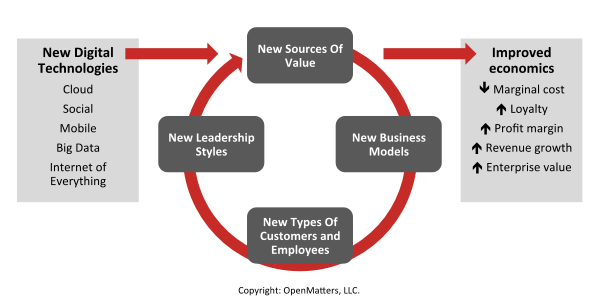
So what has changed in the last 20-30 years to require new ways of leading? Technological advancement has created a ripple effect that is transforming the market. Today’s digital technologies — social, cloud, big data analytics, mobile and the Internet of everything — have created new, intangible, sources of value, such as relationships and information that are delivered by new business models. Along with the new sources of value, customers and employees’ wants and needs have evolved as digital technologies have created new ways of interacting with businesses. Attracting, satisfying and retaining these connected and savvy stakeholders requires leaders to learn some new tricks — but there are rewards. Businesses and leaders that adapt to this new environment see economic payout with higher profit, growth and valuations, and more (see our earlier article in Knowledge@Wharton, Why Businesses Should Serve Consumers’ ‘Higher Needs’
New Leadership Styles 
So what is a leader to do given this new digitally enabled and hyper-connected environment? Employees and freelancers (such as Apple’s developer community) want ownership, impact and recognition, rather than to follow instruction. Customers want to participate in the marketing and development process (witness how consumer/business relationships have grown on social media and the rise of crowdsourcing businesses like Victors and Spoils), rather than be told what they want and why. Leaders are finding that open and agile organizations are able to respond faster and more effectively to these developments than organizations where all insight and direction comes from the top. In short, the autocratic Commander, whether brilliant or misguided, just won’t cut it anymore. Leaders need a broader range of style options to match the broader range of assets companies are creating today.
Figure 1: Disruption caused by new technology
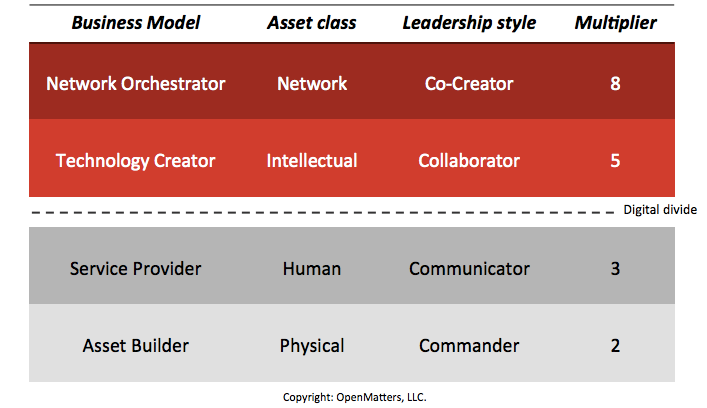
In our business model research, based on financial data from the S&P 500 companies, we found that Network Orchestrators — companies that invest in intangible assets, like relationships with customers and suppliers (Facebook, LinkedIn, Airbnb, TripAdvisor) have the highest Multipliers (price to revenue ratios) at an average of 8x (more details here). These value premiums result from rapid growth and low scaling cost, as noted by Jeremy Rifkin in The Zero Marginal Cost SocietyFurther, we identified that the different leadership styles complement some business models and detract from others because each business model leverages different types of assets, which perform best under different leadership styles.
Since most companies are actually a composite of different asset classes and business types — for example, Nike manufactures shoes (physical), but also develops some software (intellectual) and is developing a network with Nike+ (network) — most leaders use several of the four leadership styles:
Figure 2: Relationship Between Business Model, Leadership Style and Value
The Commander sets the goal and tells others how to accomplish it. This works well with machinery, which happily does what it is told, and with direct subordinates who prefer to simply execute. It is less effective with employees and customers who want choice and participation. The result in today’s world is high marginal costs and little participation and buy-in. This style is most suited to the production of manufactured, commoditized goods as it is limited by the Commander’s vision and bandwidth.
The Communicator also sets a vision and a plan, but communicates it in order to inspire and create buy-in. This works better with employees and customers who want to at least understand where “the firm is headed.” It enables them to take action in line with the leader’s vision (it scales effectively), but it does not encourage innovation. This style is suited to services firms where all employees must work to fulfill the mission.
“Leaders need a broader range of style options to match the broader range of assets companies are creating today.”
The Collaborator works hand-in-hand with customers and employees (be they full time, part time or independent) to achieve the organization’s goals. As a result, it is empowering and enabling. This style taps into the innovation of people and drives the creation of new intellectual capital. Great examples are open innovators such as Victors and Spoils, a collaborative ad agency and Merck with its crowd-sourcing competitions.
The Co-Creator allows other stakeholders to pursue their individual goals in parallel with the goals of the organization. As a result, he or she drives both rapid scaling (due to the high level of participation) and innovation. This style is at the heart of network companies where value is shared by the company and the network participants, such as Airbnb, Uber and Innocentive.com.