Showing posts with label Tips. Show all posts

Thursday, 26 February 2015

7 Ways to Increase Trust by Creating Stability


This is a guest post by Marlene Chism, author of Stop Workplace Drama. 


Uncertain times always invite a little more drama, particularly in the workplace. One reason is because the brain craves certainty. When you feel uncertain, the amygdala, an almond shaped structure in the brain shoots out chemicals through your blood stream that make you experience feelings of fear, doubt and anxiety. 


Fortunately leaders can use this information to create a sense of stability in an unstable world, which increases and eliminates much of the unnecessary drama plaguing so many workplaces today. Here are seven ways leaders can increase trust and reduce workplace drama by creating a stable environment and seven questions to help you get to the root of the problem. 


Be clear 
Just because you are unclear does not mean you have drama, but I can guarantee where ever there is drama there is a lack of clarity in some area. The lack of clarity could be in your policies, mission statement, job descriptions or even the methods of communication.  


When there seems to be negativity or any other form of drama, ask the question, “Where might there be a lack of clarity?” 


Be Consistent 
Often a leader can add to the confusion unintentionally because of personality and wiring. In my book, Stop Workplace Drama I talk about the creative genius boss and the idealist, two traits often found in high driving entrepreneurial types. The creative genius drives employees crazy with “flavor of the month” ideas and emergency deadlines only to change course at a whim. 


The idealist contributes to lack of consistency by starting out strong then losing momentum when the new wears off, or when realism sets in and resources are scarce. 


When you see the morale dipping or you sense a lack of engagement, ask the question, “How might my behaviors be perceived as inconsistent?” 


Shorten the Gap 
Most of us know from experience that plans that look good on paper don’t always work in the real world. One way to keep clarity and consistency is to shorten the gap. In other words, chunk down the goals into very small measurable parts. The idea here is to give the vision and the overview, but explain that plans may change as new information emerges. Then at the designated stopping places, celebrate the successes and then explain the next few projects and pieces and how the changes will contribute to the stated goals. 


When you get ready to make a change, always provide a pilot period for the change rather than announce the change is here to stay.  


When you see negativity, frustration or overwhelm, ask the question, “Where do I need to shorten the gap so it seems easy?” 


Keep your Word 
When you are in the midst of change, regular communication, scheduled communication and documented promises are a must. Even a simple, “I’ll get back with you” can create a sense of uncertainty and inconsistency if you don’t do what you say you are going to do. When you say, “I will let you know” or “I’ll get back to you on that,” schedule a time in your blackberry or calendar and make sure you follow through. Make your word golden and you will build loyalty and trust in your organization. 


When you stop getting ideas, curiosity and questions, ask yourself the question, “Where do I need to follow up or tie up loose ends?” 


Listen 
Every time I have interviewed employees on what makes a good boss, listening is always the first response, and respect is the second. Rather than always being the one with the answers, learn how to ask a good question. When you really listen, you increase engagement, which is always a sign of trust. The good thing about listening is remembering that you don’t have to have all the answers. When you start to feel overwhelmed, stuck or confused, ask yourself, “What could I learn from my employees if I was willing to listen?” 


Respect 
Before I became a professional speaker and trainer I had some bad habits unbeknownst to me. I would either roll my eyes, or use sarcasm as a way to keep people at a distance when I did not agree or when I felt misunderstood. I was not aware of these habits until someone pointed it out to me. Eye-rolling, interrupting, or using innuendo and sarcasm may keep people in their place, but these habits will also build a barrier instead of a bridge. In addition, you will be viewed as a persecutor instead of as a leader. 


If you perceive distance from your peers or your employees, ask yourself, “What habits do I have that could communicate disrespect?” 


Master Your Self 
William Penn said, “No man is fit to command another who cannot command himself.” As a leader, the worst thing you can do is to let your emotions rule you. No matter what the reason, flying off the handle, cursing, yelling or throwing fits does not benefit your corporate goals or inspire your team. No one wants to work for a bully or a hot head.  


Excuses such as “that’s just the way I am,” or “You would feel the same way” indicates a lack of discipline and emotional maturity. 


If you feel the pressures piling up and you have difficulty mastering yourself, ask yourself these questions: “Is my behavior and thoughts adding value,” and “How can I get my needs met so I can represent myself appropriately?” 


Leadership
Tumultuous times offer great opportunities to increase your leadership skills. Rather than focusing on the outside circumstances, now is the time to become a creator and lead from within by creating stability even in difficult times. 

Wednesday, 25 February 2015

Some of the Things I’ve Learned...

Post image for COMMENTARY 915.4: Some of the Things I’ve Learned
I hope the new year is off to a good start for you, and that you are confident that 2015 will be full of opportunities and challenges that will bring you pleasure and fulfillment.
It’s traditional to start the New Year with resolutions designed to help us live healthier, happier, and more rewarding lives. But the ritual of starting a new calendar also allows us to reflect on some of the important things we’ve learned over the years, the insights we want to pass on, and the things we’ve learned that make us not only smarter, but wiser.
For instance, I’ve learned that I am still a work in process; that as long as I can think I can learn.
I’ve learned that I still have a lot to learn but if I keep learning I will get better; and the better I get, the happier I will be.
I’ve learned that trying to be a good person doesn’t get any easier and that being a good person often requires me to do the right thing even when it costs more than I want to pay.
I’ve learned that kindness is more important than cleverness and that carrying grudges is foolish and self-defeating.
I’ve learned that my dad was right when he told me, “Where there’s a will, there’s a way,” and that tenacity is more important to success than talent.
I’ve learned that pain is inevitable, but suffering is optional and that I have a lot to say about my own happiness.
I’ve learned that a life focused on fun and pleasure rarely leads to happiness or fulfillment.
I’ve learned that in my personal relationships and in the workplace I’ve got to set limits because whatever I allow, I encourage.
I’ve learned that the things I like to do least are often the things that need to be done most.
I’ve learned that it’s easy to fall into self-righteousness and that neither the intensity of my feelings nor the certainty of my convictions is any assurance that I’m right.
I’ve learned that unless I translate my thoughts into actions, my great ideas and good intentions are like unlit candles.
I’ve learned that I cannot lie myself out of a problem and that the problems I ignore don’t go away, they just grow bigger.
Read more; http://ht.ly/IgzNe

Tuesday, 24 February 2015

4 Keys to Finding Hidden Leaders in Your Organization

Jim Kouzes writes in the foreword of The Hidden Leader that “Our images of who’s a leader and who’s not are all mixed up in our preconceived notions about what leadership is and isn’t.” Well put. That is the issue. 

He goes on to say that “hidden leaders are those people in your organization who share the belief that what they do matters.” And they are all around us. 

The authors Scott Edinger and Laurie Sain have developed some key indicators for finding the hidden leaders in your organization or team. These people can be “defined, identified, nurtured, and encouraged to help an organization develop a competitive edge.” Some will accept a position and others will prefer to stay off the organizational chart, but all can drive excellence throughout the organization. 

Hidden leaders display four key identifiers: they demonstrate integrity, lead through relationships, focus on results, and remain customer-focused no matter what role they have in the organization. Let’s look at them one by one: 

Demonstrate Integrity. Edinger and Sain believe that this is the “absolute bottom-line requirement of hidden leadership.” It means a consistent display in thoughts and actions of a strong ethical code of conduct that is “focused on the welfare of everyone.” Their consistent adherence to their beliefs makes them predictable and therefore dependable. They have the courage to do the right thing even when it is difficult. 

Lead Through Relationships. Leading through relationships is the basis of leadership. They get along with others and value others. They “lead and inspire because of who they are and how they interact with others.” They don’t depend on their position or lack of it to influence the actions of others. 

Focus on Results. The hidden leader “maintains a wide perspective and acts with independent initiative.” They use the end to define the means, which can mean working outside of strict processes to achieve the end result. “They aim for the end they are supposed to produce” so “they feel responsible and accountable, not just for the demands of their jobs but also for successful outcomes for stakeholders involved.” 

Remains Customer Purposed. This is different than customer service; it is an “awareness of how an action in a specific job affects the customer.” It is a big-picture focus and having a deep understanding of the value promise of an organization. 

For some hidden leaders one characteristic may dominate and others may need to be fully developed, but a hidden leader who lacks integrity, isn’t a hidden leader. Any leader needs support from other leaders in the organization and a good leader will make a priority out of developing others. 

Hidden leaders are easier to spot in flatter organizations and those that provide a greater number of areas to contribute. Listening to people at all levels is a big part of that. 

By recognizing hidden leaders we help to create a culture that develops more leaders. The hidden leaders are there. It is a leader’s responsibility to discover and develop them. 

Read more; http://www.leadershipnow.com/leadingblog/index.html

Monday, 23 February 2015

12 Things That Successful Leaders Never Tolerate

By and large, tolerance is a good trait. The differences we encounter enrich our lives and organizations. But to attain a successful life and meaningful leadership, we must refuse to tolerate the things that deplete, and ultimately destroy, us.
Start by declaring these things intolerable in yourself and those around you--and see what changes as a result.

1. Dishonesty

Living an honest life allows you to be at peace with others and yourself. Dishonesty imposes a false reality on your life and those around you.

2. Boredom

Successful people are generally exploring something new. Life is too short for inactivity and staying in your comfort zone.

3. Mediocrity

It's easy, and a constant temptation, to settle for less. But what makes some people stand out is their willingness to make the hard choices that allow a life of greatness.

4. Negativity

5. Toxicity

At work or at home, a toxic environment will literally make you sick. If it doesn't feel right, if it makes you tired or fills you with dread, cut yourself loose.

6. Disorganization

Clutter and disorder cause stress and affect your emotional and mental well-being. Get rid of what you don't need and keep everything else where it belongs.

7. Unhealthy anything

Unhealthy food, unhealthy relationship, unhealthy habits--choose what you do wisely. Remind yourself that you deserve better, and then give yourself better.

8. Regrets

We all have regrets, but you can't move toward your future if you're dwelling on the past. Learn from it, right any wrongs where you can, and leave it behind.

9. Disrespect

Relationships are at the heart of success, and respect is at the heart of good relationships. Disrespect--whatever the form and whomever it's directed toward--is one of the most destructive forces you can harbor.

10. Distrust

Distrust often arrives through a succession of little compromises here and there, so be watchful. Focus on building your own integrity and surround yourself with others who do the same.

11. Anger

We all feel anger, and in its place it can move you to action. But holding onto anger is paralyzing and accomplishes nothing. Learn to direct anger toward problems, not people, and then get over it.

12. Control

Don't worry about the things you can't control. Focus your energy where it can do good, and learn to let go of the rest.
Pay attention to the difference between the things that are truly positive in your life and the things you just let happen.
Remember, you are sum of what you tolerate!

Monday, 16 February 2015

Guidelines to Create a Compelling Vision

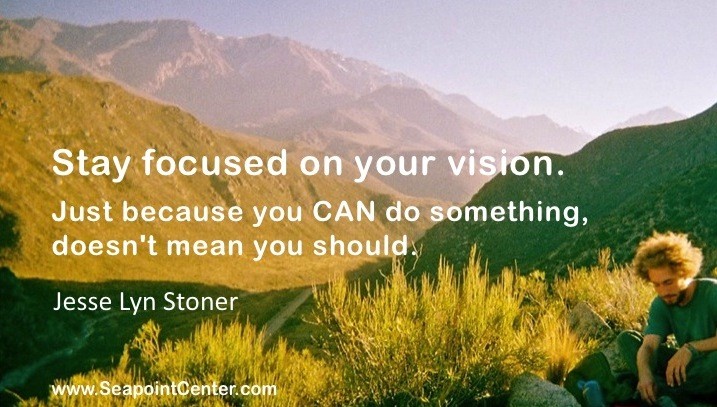
stay_focused_on_your_vision_quote
A compelling vision helps you make choices about where to focus your energy. Without vision, you are in danger of trying to be all things to all people, scattered or adrift.
In our book, Full Steam Ahead! Unleash the Power of Vision, Ken Blanchard and I explain:
“Vision is knowing who you are, where you’re going, and what will guide the journey.”
Who you are is your purpose. Where you’re going is your picture of the future. What will guide your journey are your values.

Vision is about being great 

A noble purpose is inspiring and helps you stay committed when times are hard.
A compelling vision is not about beating the competition or expressed simply in numbers. It’s about being the best you can be. Being “number one” might be a goal, but where do you go from there? Your vision will continue to guide you by answering, “what’s next?” as each goal is achieved.
Vision is clear and specific. It’s not just “positive thinking.”  It shows you a picture of what “being great” looks like for you.

3 Guidelines to Surface Your Vision

1. Relax and have fun. 
To create a vision, you must first connect with what you care most deeply about. Suspend your internal judge and critic. Dig below the surface and see what arises. Be creative and playful. Give yourself permission to explore, to dream.
Do not let your fears and concerns limit your thinking. A vision can overcome seemingly insurmountable obstacles. If you have any doubts about this, consider the story of Terry Fox.
You can use the logical part of your brain later to shape your vision, but first reach for your deepest dreams.
2. Be proactive, not reactive. Focus on what you desire, not what you want to get rid of.
There is more power in focusing on what you desire than on removing a problem. If you are are focused primarily on what you don’t want, you might remove a specific problem, but you are likely to move simply from one crisis to another – because you’re not focused on where you’re going.
If you you must focus on removing a problem, pair it with a proactive focus.  For example, if you want to lose weight, you need to eat less. However, if you are frequently thinking about the chocolate you are not eating, it’s difficult to maintain motivation over the long term.  Try also picturing what you’ll look like in your new jeans. Or if you’re quitting smoking, imagine yourself in your old age taking a hike or reading a book to your grandchildren.
3. Focus on the end result, not the process to get there.
The power of vision comes from creating an image of the end result. The process for achieving it, the path, will not necessarily be clear.
In the late 1970’s, the technique of “mental rehearsal’” became popular in sports training – where the athlete visualized his or her performance during the competition. Over the years, sports trainers discovered that the real power was in visualizing the end result— celebrating the victory or seeing yourself standing on the podium receiving the gold medal.
Imagine that the future is just as you wished it would be. What is actually happening? See vivid images that show what your purpose is, what your values are, and what you are doing.
Read more; http://ht.ly/HJXNT

Sunday, 15 February 2015

You’re the boss. Make a difference.

Bosses: You’ve got the power

“The upshot of these and so many other studies and stories is that bosses pack a wallop, especially on their direct reports. Bosses shape how people spend their days and whether they experience joy or despair, perform well or badly, or are healthy or sick.”
That’s from Bob Sutton’s great book, Good Boss, Bad Boss. If you are a boss, you’re the single most important factor in determining the morale and productivity of your team.

Make your team a great place to work

There are companies that are great places to work. But for most people, most of the time, the boss does more to determine whether where their work experience is great or not. Their experience working on the team is the most important reality.
I’ve seen wretched companies where some people loved coming to work because of their boss. And I’ve watched awful bosses make working for a great place to work company more like working at a penal colony.

Yes, the company has an impact

There are things you can’t control. You don’t determine whether the company pays a living wage. You don’t have a say in what’s in the policy manual or the process of getting expenses paid or vacation approved. But that’s no excuse

You affect most of the important things

You can help your people grow and develop, and you should. That’s your job. You can treat people fairly, like responsible adults. You can say “good job” or “great effort” or “you’re making progress” even if your company doesn’t seem to care. You can help team members build on their strengths and make their weakness irrelevant. You can take the blame when things go bad and hand out credit freely when they go well. In other words, you can make a difference.

How you make a positive difference

Start by getting to know your people and their work and help them get to know you. Show up a lot. Have conversations. They’re the way relationships grow and grow strong.
Look for legitimate reasons to praise team members. Praise achievement, progress, and effort. Praise honest attempts to do something different, even if the outcome isn’t so great.
Imagine yourself as team enabler. Help people do better. Help them work together better. Remove impediments that get in the way of good work or high morale.

Boss’s Bottom Line

You have the biggest impact on the productivity and morale of the team. Use that power for good.

Saturday, 14 February 2015

How Do Trustworthy Leaders Behave?


Ed Catmull and colleagues
Pixar and Disney Animation president Ed Catmull (left) has instituted workshops designed to educate colleagues about how the company views trustworthiness. | Reuters/Regis Duvignau
It can be easy to trust too quickly, especially when a leader is affable, has an impressive résumé, and tells you what you want to hear. In 30 years of surveying senior executives, social psychologist Roderick Kramer has found that 8 out of 10 report being burned at least once because they trusted too much or put their faith in the wrong person at some point in their careers.
It’s important for an organization to build trust among workers for several reasons, says Kramer. Employees who know they can trust their leaders are happy workers who believe in what they are doing. Creating this trust from within can also lead to public trust. “A lot of leaders talk about public trust, then they focus on the impression-management side of things,” says Kramer, “it’s much more important to establish genuine trust within your organization, which leads to trustworthy performance, which then builds over time into a public reputation of being trustworthy.”
With surveys from Edelman, Harvard’s Center for Public Leadership, and others reporting public trust in business and government leaders at near historic lows, Kramer says it’s a good time for leaders to build a trustworthy reputation. “People are looking for leaders they can trust, and so there’s a lot of capital sitting on the table for leaders who can get the equation right.” So how do truly trustworthy leaders behave?

They project confidence, competence, and benevolence.

Research shows that trustworthy leaders demonstrate that they have the skills and knowledge to steer the organization, that they don’t shy from straight talk, and that they are acting in the best interests of the organization, rather than in their own best interests.
“These things sound obvious, but still it’s important to look for ways to communicate them,” says Kramer. “Several people have written about the importance of leading by walking around — being present, accessible. Leaders like this leave a good impression as tangible, real people.”

They say — and show — that trust is an important company value.

In a way, good leaders are trust teachers, says Kramer. “They talk about the importance of trust, so that people know the leader values it, and that there will be consequences if that trust is violated.” He notes that at Pixar, a company known for creating animated films that kids love and parents can trust, CEO Ed Catmull has instituted workshops specifically to educate colleagues about how the company views trustworthiness.
As an example of demonstrating trust in employees, Kramer cites Whole Foods CEO John Mackey and his policy whereby employees directly hire new people to work on their teams, rather than relying on a system of centralized hiring through HR. “He’s pushing the decision-making process from the top down to the people who are going to have to live with the consequences of those decisions, and that doesn’t happen in many organizations,” says Kramer.

They establish clear roles and systems to speed trust.

While one leader’s behavior can set a tone of trustworthiness, the entire company needs to have rules that enable trust to permeate a group’s culture, Kramer has found in his research. “When people know what they’re supposed to do, and they know what other people are supposed to do, then they trust that system of roles to work.”
He points to Pixar’s “Braintrust,” which Catmull describes in his book, Creativity, Inc., the process by which the company’s top minds relentlessly vet creative ideas and identify a project’s problems. Because the system is so rigorous and well defined, it engenders trust in the ideas that are deemed good enough to move forward. “And once you’ve had a history of success with that culture of rules, it becomes a background expectation,” says Kramer, a state he calls presumptive trust, which in turn leads to trustworthy performance.

They share the credit, and they take the blame.

Because leaders are highly visible, people both within an organization and outside the organization tend to overweight their responsibility for successes and failures, a phenomenon the late Harvard scholar Richard Hackman called the “leader attribution error.” For example, look at the success of the late Steve Jobs, says Kramer. “Many creative minds at Apple contributed to the development of the iPhone, but in the mainstream Jobs got the credit.”
Leaders can beneficially exploit this phenomenon to build trust by being out in front of the organization’s decisions, says Kramer, so that when good things happen, people recognize that the leader was in charge of the process, even though he or she might share the credit. “And there’s a little bit of evidence that suggests that when leaders are generous at sharing credit, they actually are more trusted,” he says. “It shows that they are fully confident.” Likewise, demonstrating confidence by admitting full responsibility when something goes wrong — even if the leader wasn’t fully responsible — can in some cases enhance a leader’s reputation.

They don’t mask a crisis.

"One of the fatal mistakes many organizational leaders make is not the initial misstep that causes the crisis; it’s the cover-up — the attempt to spin it or mask the problem,” he says. People quickly lose confidence in leaders who do this, says Kramer, pointing to bankers during and following the 2008 financial crisis. “I think some of the disenchantment with Wall Street was that leaders didn’t really take responsibility for their errors,” he says. “They blamed the system, or imprecise regulation — and people don’t like that because it’s a dodge.”
Instead, Kramer suggests, acknowledge the problem quickly, take swift and decisive action to address it, and put in place measures to prevent its reoccurrence. If the problem involves a defective product, recall it “and make a very public display of the new safeguards or policies that will prevent it from happening again.” In a recent book with Todd Pittinsky, Restoring Trust in Organizations and Leaders, Kramer suggests it is possible for leaders and organizations to regain the public’s trust, but it isn’t easy.
Read more; http://ht.ly/IbJIf

Monday, 9 February 2015

Why we need a management shift

Management shift
The media paints a fairly negative picture of the workplace. Wages are too low. There’s gender inequality. Work-life balance is a problem. Productivity or skills are poor. There are scandals of every variety and mistakes in mergers, outsourcing and financial trades. Today’s workers are frustrated, unproductive and miserable – or so you would think from the coverage.
Is this really an accurate picture? And to the extent that such problems do exist, can we improve things? Are we really, in Western society at the beginning of the 21st Century, just terribly bad at management?
Over the past 20 years, I’ve had the opportunity to research in great depth what makes for strong leadership and an effective workplace, and I’ve put some ideas and models into action. I’ve learned three key lessons:
  1. It isn’t all bad – there are some great leaders and fantastically dynamic workplaces.
  2. The difference between the best and the worst workplaces is huge.
  3. Leadership is a defining quality of an effective, productive workplace.
The challenge is converting this knowledge to action. It goes beyond implementing new
processes and methods—mindsets must also be changed. It’s actually a historic shift away from the exploitative mindset: “Let’s squeeze every drop out of the people and environment to feed the company” towards an empowering mindset: “Let’s harness people’s energy and ambition to create an innovative and resilient enterprise.”

This better alternative is not just an option for trendy hi-tech or creative firms, but for every enterprise, whether you’re in design or food production. It’s actually the way in which the most resilient and successful businesses have always governed their affairs. It’s not utopic and not everything works all the time, but there are certain core habits and principles that maximise the potential for success.
“The Management Shift” is a shift:
  • From a controlling mindset to an empowering one.
  • From setting rules to establishing principles.
  • From issuing instructions to creating teams.
  • From overseeing transactions to building alliances.
  • From a focus on short-term profits to serving all stakeholders.
In short, we know how to make workplaces more productive, engaging, innovative and rewarding. The challenge is a cultural one: to grasp that this transformation is possible and to learn the disciplines to make it happen.

Sunday, 8 February 2015

How’s Your Leadership…Positive or Polluted?

Toxic Leadership - GeneralLeadership
“It is a shame that so many leaders spend their time pondering their rights as leaders instead of their awesome responsibilities as leaders.”

 James C. Hunter
General George Washington and General Benedict Arnold were both effective leaders; however, their lasting effects on their organizations were profoundly different. Although both men were heroes of the continental Army, one went on to become the father of our country and is universally viewed today as an exemplar of selfless and inspiring leadership. The other became our nation’s most notorious traitor. His name evoking thoughts of someone who’s pride and self-oriented actions led him to sell out his young nation in hopes of personal fame, glory, and reward.
Two leaders. Both gifted. One added value and left his surroundings better than he first found them. The other’s unchecked ambition and inability to keep his toxic tendencies in check resulted in a legacy of disillusionment, betrayal, and mistrust.
We have all likely endured the overly ambitions boss or overbearing leader.  However, leaders with toxic-tendencies are something more. Rather than creating conditions for people to flourish and thrive and come fully alive, their destructive tendencies sap our strength and steal our joy. Their toxicity is a contagion which, in time, pollutes the culture of the entire organization.
The term “toxic leadership” is often used to describe those who have a profoundly negativeeffect on others. Be it a promise-breaking politician; arrogant or ignorant media personality; greedy corporate executive; demanding and demeaning military leader; or anyone else who routinely undermines, demeans, or micro-manages subordinates, toxic leadership has become all too commonplace. Much like General benedict Arnold, those men and women in positions of power and influence who possess an almost narcisstic preoccupation with themselves and their agendas do much more harm than good.
Richard Wagner, in his book Smart People Doing Dumb Things: The Case of Managerial Incompetence, shares how individuals with toxic tendencies are often the first to take more credit than they deserve when things go well and are often the first to point fingers of blame when they do not.  Rather than leading in a manner that creates strong bonds of mutual trust and respect in order to facilitate mission accomplishment, toxic leaders generate serious and enduring poisonous effects—fostering a climate of fear, distrust, divisiveness, selfishness, and a host of other unhealthy and unproductive conditions.
In their insightful article entitled Narcissism and Toxic Leaders, Lieutenant Colonel Joe Doty and Master Sergeant Jeff Fenlason note that leaders with toxic tendencies are also notoriously:
  • Poor listeners;
  • Overly sensitive to criticism;
  • Willing to take advantage of others to achieve their own goals;
  • Intent on seeking every opportunity to be in the spotlight;
  • Uninterested in others opinions, ideas or feelings; and
  • Prone to conduct themselves with an air of self-importance that’s impossible to miss.
That’s quite a sad list, if you ask me. And the fact of the matter is, toxic leadership is neither new nor limited to a particular industry.
So what can each of us do to help prevent ourselves from exercising or expressing toxic tendencies? Try these simple practices:
Don’t Foster Blindspots. Going through life without asking for feedback is like driving in a foreign country without ever stopping to ask directions. One of the best ways to guard against developing toxic tendencies is to periodically ask those you know for their candid and constructive feedback. Determine if the way you see yourself is accurate with how others perceive you. Assess if your words and your ways, your tone and your temperament, carry tinges of arrogance or hints of haughtiness. Be open and genuinely interested in others feedback about your performance.
Don’t Be a Decision-Deflector. One of the single biggest ways a leader can undermine confidence and breed complacency is to be indecisive. Rather than step into their role as a decision-maker, leaders with toxic tendencies tend to deflect decisions, especially challenging or unpopular ones, for fear of looking incapable or incompetent. If this describes you, stop. Assert yourself when necessary, and take advice when needed.
Don’t Be Emotionally Hijacked:  Don’t allow your emotions to get in the way of your success. Knowing when to practice self-control and self-discipline communicates a sense of consistency and maturity to those around you.
Don’t Dodge Disappointment: Although setbacks, failures and disappointments can be a very real byproduct of leading, those with toxic tendencies often strive to play it safe. Given their insistent need to guard their egos and protect their public personas, toxic leaders prefer to dodge disappointment rather than recognize that risking  the sting of defeat is what could very well unlock opportunities for growth.
Don’t Be Afraid to Raise Your Hand:  Leaders with toxic tendencies are quick to reject responsibility. They refuse to accept the consequences of outcomes anytime doing so threatens their self-perpetuated myth they are too good to err. Don’t let that be you. Remember, sometimes your role as leader means having to shoulder the responsibilities of others’ actions. Are you ready to improve your leadership skills? Adopting some or all of these traits could be a step in the right direction.
Don’t Wield Power Over Others. Leaders with toxic tendencies routinely forget their primary job is to effectively guide others to achieve mutually beneficial goals and objectives. It’s not to indiscriminately wield power over them. If you are operating effectively as a leader, you likely have figured out the value you add is often invisible. It is what those around you achieve that truly validates your role, not what you do to promote yourself. Keep any toxic tendencies at bay by focusing on enabling others to succeed. Strive to liberate their talent and potential then, get out of their way.
Toxic leadership demotivates individuals and damages organizations by decreasing the commitment and motivation of their members. The negative outcomes caused by leaders with unchecked toxic tendencies create lasting and enduring harm to an organization’s culture and climate. As Ron Kaufman reminds us, “The culture of an organization is like a river. It can be fluid, strong and consistent, serving as lubricant while guiding its members in the right direction. In contrast a river can become stale and toxic, silently killing those who drink at its shore.”
What kind of culture are you promoting? Is it positive, energizing and inspiring others to be and do their best? Or is it polluted, stagnant and stifling, draining those around you of their energy, creativity, and potential?
Read more: http://ht.ly/Hg9wN